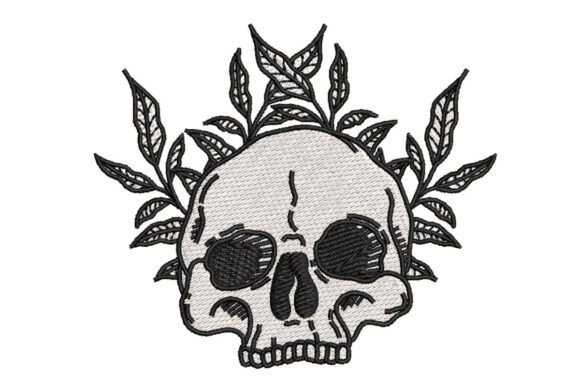
Floral Skull with Leaf Crown Embroidery Design
A Gothic-Natural Balance That Actually Stitches Well
First impression? This isn’t just another skull motif. The Floral Skull with Leaf Crown Embroidery Design lands somewhere between botanical illustration and quiet reverence—no cartoonish edge, no overwrought drama. The skull’s texture reads as soft graphite or charcoal, not harsh line art, and the leaf crown flows organically, not like a rigid halo. It feels intentional, mature, and quietly confident. I immediately pictured it on a heavyweight linen tea towel for a boutique kitchen line—not as shock value, but as thoughtful contrast: life and legacy, decay and growth, all in one shape.
Where It Shines in Real Projects
I tested this Floral Skull with Leaf Crown Embroidery Design across three real-use scenarios: a medium-weight organic cotton tote bag (for a local herbalist’s shop), a relaxed-fit unisex sweatshirt (as a limited-edition holiday gift), and a 4-inch embroidered patch sewn onto denim aprons for a craft fair stall. In every case, the design held its character without flattening or bleeding. The leaf crown’s curves translated cleanly into satin stitch, and the skull’s subtle texture came through beautifully in layered fill stitch—no pixelation, no “busy” density that overwhelms fabric drape.
It works especially well for small business owners who want to signal sophistication without sacrificing approachability. Etsy sellers crafting personalized gifts will find it resonates with customers seeking meaningful, non-generic symbolism—think baby embroidery on a neutral onesie (with leaf tones softened to sage or oatmeal) or wedding guest favors stitched onto linen sachets. As a machine embroidery design, it scales cleanly down to ~3.5 inches without losing legibility, making it versatile for caps and pillow covers—but more on sizing limits in a moment.
Where to Pause—and Test First
This isn’t a “drop-and-stitch” file for every surface. On stretchy fabrics like lightweight knits or ribbed t-shirts, the skull’s fine internal contours can blur if stabilizer isn’t matched precisely. I recommend a light cutaway + tear-away combo—not just standard tear-away—especially around the eye sockets and leaf vein details. On dark fabric, test thread colors carefully: the original light grey rendering relies on tonal contrast, so switching to black thread on navy creates a bold graphic; switching to ecru on charcoal yields something quieter, almost archival.
Curved surfaces demand attention too. When I hooped it on a structured cap front, the left-side leaf branch compressed slightly at the curve—nothing unusable, but enough to warrant a quick repositioning or slight rotation before final hooping. And while it’s labeled under Shapes, don’t assume it’s purely outline-based: those leaf veins are running stitch accents, not just fill boundaries. That means stitch density matters. On thin fabrics like chambray or baby swaddle cloth, skip heavy backing and opt for a medium-weight fusible stabilizer instead—dense fill + flimsy fabric = puckering.
Design Integrity Meets Customer Trust
Here’s what surprised me: how often customers paused mid-browse to ask about the meaning behind it. Not “What is that?”—but “Is that handmade? Who designed it?” That tells me the Floral Skull with Leaf Crown Embroidery Design reads as intentional craftsmanship, not clipart. That perception directly lifts perceived product value. A $38 embroidered pillow cover feels like a curated object—not a mass-produced item—because the design carries weight, rhythm, and restraint. For craft businesses, that translates to stronger brand consistency and higher buyer engagement, especially among shoppers who prioritize story and subtlety over trend-chasing.
It also avoids the “too literal” trap common with gothic motifs. No bats, no roses dripping blood, no skulls grinning. Just quiet balance. That makes it unexpectedly flexible: appropriate for a gender-neutral nursery wall hanging, a barista’s apron at a specialty coffee shop, or even a tasteful holiday embroidery on a wool-blend blanket. Its strength lies in what it *doesn’t* say—leaving room for the wearer or recipient to project their own meaning.
Practical Designer Notes Before You Stitch
- Always test on scrap fabric first—especially with your exact thread/stabilizer/fabric combo. What looks balanced in a digital preview may shift in stitch.
- Review stitch density in your embroidery software. If the leaf crown feels too dense for your fabric weight, reduce fill angle or add slight spacing—don’t just shrink the whole design.
- Check hoop size requirements. Even if it fits in a 4x4 hoop, consider whether the outermost leaves sit too close to the edge for clean hooping on curved items.
- Inspect small details at 200% zoom: eye socket depth, leaf tip sharpness, stem taper. These define clarity in the finished product.
- Test it in black-and-white mockups. Does the contrast hold? Does the skull read as dimensional—or flat?
- Compare light and dark fabric backgrounds side-by-side. This design lives in the mid-tones; extreme contrast can mute its nuance.
- Confirm licensing terms before selling finished items or bundling the digital embroidery file with other design assets. Not all Embroidery files permit commercial resale of stitched goods without attribution or extended license.
Final Thought: A Shape With Substance
The Floral Skull with Leaf Crown Embroidery Design isn’t just another silhouette—it’s a conversation starter with quiet authority. It belongs on products where craftsmanship is visible, where buyers care about intention, and where “handmade” means something beyond technique. Whether you’re an Etsy seller building a cohesive collection, a small shop owner refreshing seasonal merchandise, or a designer curating embroidery project kits, this shape earns its place—not because it’s trendy, but because it stitches true, reads clearly, and holds space for meaning. Just remember: respect the fabric, honor the detail, and let the balance speak for itself.